
I think the kube state metrics api is one of the most important topics in Kubernetes monitoring.
That is why I decided to write this guide. I will also share my own experience so the topic feels real.
We should always learn monitoring step by step. If we understand the basics clearly then Kubernetes becomes easy.
What Is Kube State Metrics API
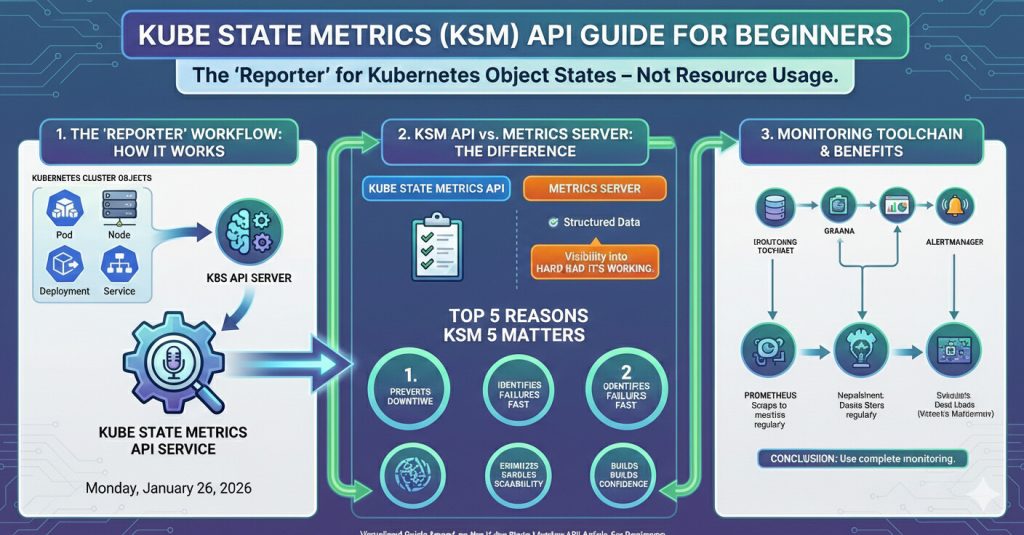
Kube state metrics api is a service that exposes information about Kubernetes objects. It does not collect CPU or memory usage. It shows the state of resources.
These resources include pods. These resources include nodes. These resources include deployments. These resources include services.
I learned that the kube state metrics api works like a reporter. It reads data from the Kubernetes API server. Then it converts that data into metrics format.
Monitoring tools can read this data easily. That is why it is very important.
Why Kube State Metrics API Matters
Kubernetes is powerful. But power also brings complexity. Kube state metrics api helps us understand what is happening. It shows if pods are running. It shows if deployments are ready. It shows if nodes are healthy.
I realized that good monitoring saves time. It also prevents downtime. That is why the kube state metrics api matters.
My First Experience With Kube State Metrics API
When I first used Kubernetes I only checked pod status manually. That worked for small clusters.
I installed Prometheus. Then I learned about the kube state metrics api. Suddenly everything became clear.
I could see deployment status. I could see the replica count. I could see failed pods quickly.
That experience changed how I manage clusters. It taught me that monitoring is not optional. It is necessary.
How Kube State Metrics API Works
Kube state metrics api connects to Kubernetes API server. It reads object data.
It exposes metrics through an HTTP endpoint. Monitoring systems scrape this endpoint. They store the data.
If Prometheus is used it scrapes metrics regularly. Then dashboards display the data.
This flow is simple. But powerful.
What Data Kube State Metrics API Provides
Kube state metrics api provides many useful metrics. These metrics are about object state.
Examples include pod readiness. Examples include deployment availability. Examples include node condition. Examples include job completion.
These metrics help us answer questions. Are pods running? Are replicas matching the desired count. Are nodes ready.
If we know this we can fix problems early.
Difference Between Metrics Server And Kube State Metrics API
Many beginners confuse these two. I also did at first.
Metrics server shows resource usage. It shows the CPU. It shows memory.
Kube state metrics api shows object state. It shows configuration status. It shows readiness.
Both are important. But they serve different purposes.
We should use both for complete monitoring.
How Monitoring Tools Use Kube State Metrics API
Monitoring tools need structured data. Kube state metrics api provides that.
Prometheus scrapes the metrics. Grafana displays dashboards. Alertmanager triggers alerts.
This chain works smoothly. That is why we should always include it.
Common Use Cases Of Kube State Metrics API
We can use kube state metrics api to monitor deployments. We can check if replicas are available.
We can monitor pods readiness. We can detect crash loops.
We can monitor node conditions. We can track job completion.
All these use cases improve reliability.
How Beginners Can Understand Metrics Easily
Metrics look scary at first. But they are simple if explained well.
Each metric has a name. Each metric has labels. Each metric has a value.
If we read them slowly we understand them. We should not panic.
I learned that practice makes metrics friendly.
Setting Up Kube State Metrics API In Simple Way
Most clusters install kube state metrics using Helm. Helm simplifies installation.
After installation a service runs in the cluster. It exposes the API endpoint.
Monitoring tools connect to it. Data flows automatically.
We should always verify that the service is running. That avoids confusion later.
SEO Benefits Of Kubernetes Monitoring Content
Technical content attracts quality traffic. Users searching kube state metrics api want answers.
If content is clear users stay longer. If users stay longer search engines trust the site.
That helps ranking. That is why clear guides are powerful.
Why Beginners Should Learn Kube State Metrics API Early
Monitoring is not advanced only. It is foundational.
If we learn early we avoid bad habits. We build reliable systems.
I wish I had learned this earlier. That is why I encourage beginners to start now.
FAQs
What is the kube state metrics api?
It is a service that exposes Kubernetes object state metrics.
Is the kube state metrics api required?
Yes if you want strong monitoring.
Can beginners use it easily?
Yes, if explained simply it is easy.
Is it safe to use in production?
Yes if access is secured properly.
Conclusion
I think the kube state metrics api is a must have for Kubernetes monitoring. It helps us understand cluster state clearly. It gives visibility into resources. It prevents silent failures.
If we want stable clusters we should use it. If we want confidence we should monitor properly.
This guide was written to make learning easy. I hope it helps you understand the kube state metrics api clearly. If you follow these ideas you will manage Kubernetes better.