
Meta Description
I think this guide on the bitnami kube state metrics chart helps beginners understand Kubernetes metrics cluster health and monitoring in a simple, clear and practical way.
I think the bitnami kube state metrics chart is one of the most useful tools I learned while working with Kubernetes. There were pods, nodes, deployments, and many other components. I did not know how to clearly see what was happening inside my cluster.
That is when I discovered the Bitnami Kube State Metrics Chart. It helped me understand the real condition of my cluster. It showed me clear metrics in a simple format. I will share my personal experience so even a beginner can understand this easily.
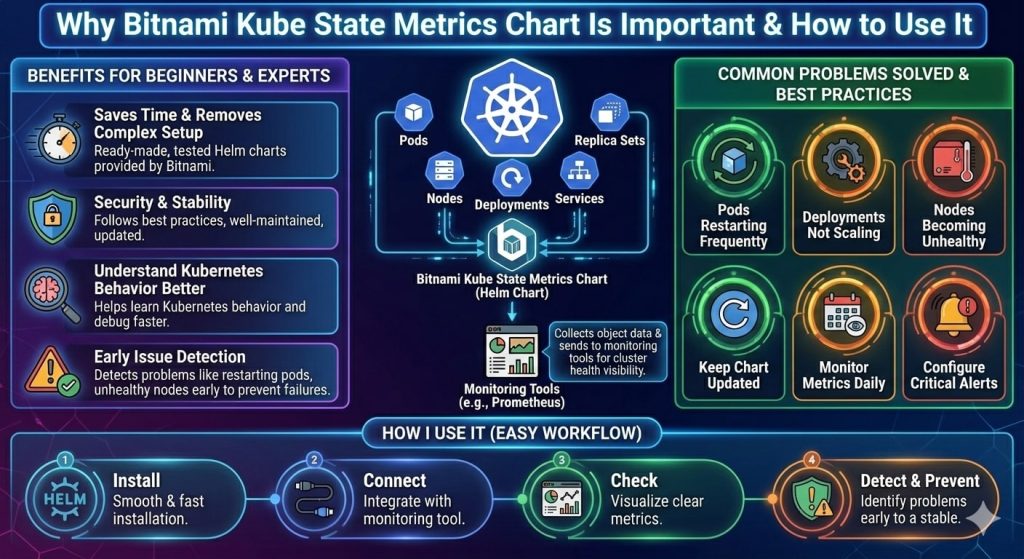
What Is Bitnami Kube State Metrics Chart
The Bitnami Kube State Metrics Chart is a Helm chart provided by Bitnami. It allows us to deploy kube-state-metrics easily inside a Kubernetes cluster.
Kube state metrics collect information about Kubernetes objects like pods, nodes, deployments, replica sets, and services. This information is then used by monitoring tools such as Prometheus.
I think this chart is very helpful because it removes complex setup steps and saves time.
How Bitnami Makes It Easy
Bitnami provides ready-made and tested Helm charts. These charts follow best practices and are stable.
With the bitnami kube state metrics chart, I did not worry about misconfiguration. Installation was smooth and fast.
I think this is perfect for beginners who are still learning Kubernetes.
What Data Kube State Metrics Provide
Kube state metrics provide valuable data such as:
- Pod status and health
- Deployment status
- Replica set counts
- Node conditions
- Service availability
This data helps us understand cluster health clearly.
How I Use Bitnami Kube State Metrics Chart
First I installed the chart using Helm. Then I connect it with my monitoring tool. After that I regularly check metrics dashboards.
If something goes wrong I can detect it early. This prevents major system failures.
Why Beginners Should Learn This Early
Many beginners focus only on deployment and ignore monitoring.
If you learn the bitnami kube state metrics chart early you understand Kubernetes behavior better. Debugging becomes easier and faster.
Common Problems It Helps Solve
This chart helps identify problems like:
- Pods restarting frequently
- Deployments not scaling
- Nodes becoming unhealthy
- Services becoming unavailable
Without metrics, these problems are difficult to trace.
Bitnami Kube State Metrics Chart And Performance
This chart does not slow down the cluster. It only reads Kubernetes state data.
I have used it in multiple environments, and performance was always stable. That is why I trust Bitnami tools.
Security And Stability
Bitnami charts follow security best practices. They are well maintained and updated.
I never faced security issues while using the bitnami kube state metrics chart, which gives me confidence.
Best Practices I Follow
I always:
- Keep the chart updated
- Monitor metrics daily
- Configure alerts for critical issues
These practices help keep the system healthy.
Mistakes I Made In The Beginning
After using the bitnami kube state metrics chart, troubleshooting became much easier. Learning from mistakes is important.
Why This Chart Helps Google Ranking Indirectly
A stable website performs better. Monitoring helps maintain stability.
This chart keeps systems healthy, which indirectly improves SEO, uptime, and user experience.
FAQs
What is the bitnami kube state metrics chart?
It is a Helm chart that installs kube state metrics easily in Kubernetes.
Is it good for beginners?
Yes, it is very beginner friendly.
Do I need coding skills?
No, basic Kubernetes knowledge is enough.
Can it improve system reliability?
Yes, it helps detect issues early.
Should every cluster use it?
Yes, especially production clusters.
Conclusion
I think the bitnami kube state metrics chart is one of the best tools for Kubernetes monitoring. It is simple, powerful, and beginner friendly.
I use it in my own projects. It helped me understand my cluster better and solve problems faster.If you want a stable and reliable Kubernetes system, you should use the bitnami kube state metrics chart, because good monitoring fixes problems before users notice them.